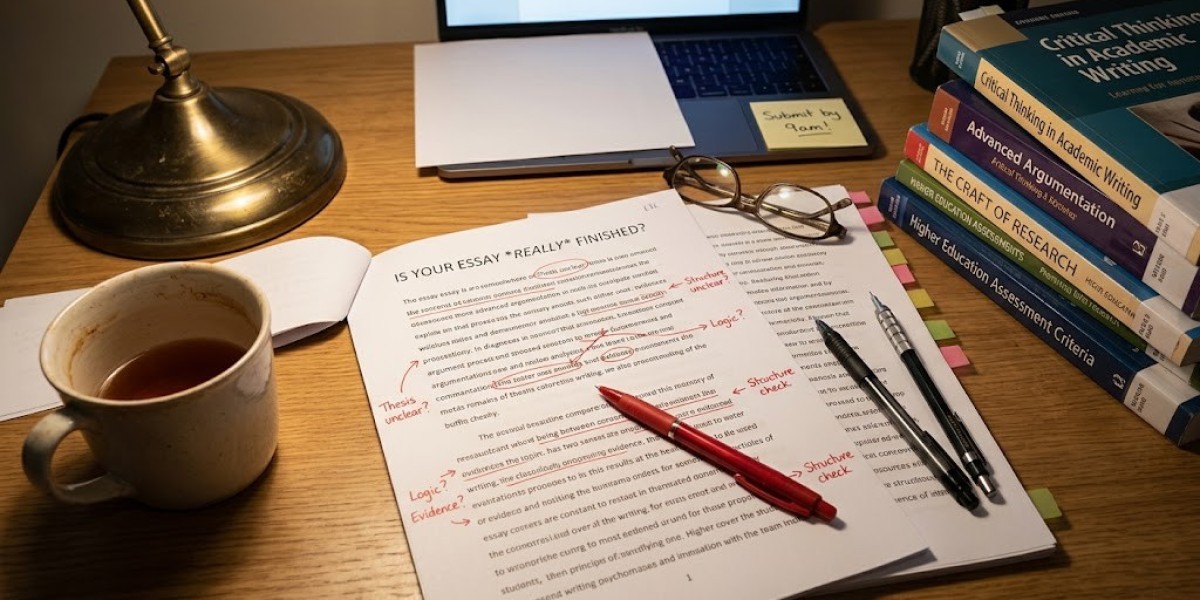
It's 1 am, the word count finally hits the target, and your whole body relaxes. You did it. You're done.
Except… you're not. Not really.
Here's a truth that almost nobody tells students until it's too late hitting: your word count doesn't mean you've written a good essay. It means you've written an essay a rough, unfiltered dump of everything you know about the topic. Ask any professor who has graded thousands of papers and they'll say the same thing: most lost marks have nothing to do with weak research. They happen in that last stretch, when a tired writer submits a first draft and calls it a final one.
A first draft is you talking to yourself. A finished essay is you talking to a stranger clearly enough that they don't need you in the room to understand it. That gap is where real grades are won or lost. So before you hit submit, here's how to actually check if your essay is ready, not just written.
Step 1: Make Sure You Answered the Right Question
This is the single most heartbreaking mistake in academic writing a well-researched, beautifully written essay that scores low because it quietly drifted off-topic.
It usually happens without the writer noticing. You find a fascinating article on something almost related to the prompt, and your essay slowly bends toward the easier, more comfortable subject. By the third page, you're writing about what you know instead of what you were asked .
Before touching a single sentence for style, go back to your assignment brief and ask two blunt questions:
- What's the verb doing? Were you told to analyze , compare , or evaluate and did you accidentally just describe instead? Description is the easy, low-reward version of academic writing. Analysis is where the marks actually live.
- Did you deliver what you promised? If your introduction said you'd examine three case studies, did the third one get a real paragraph, or one rushed sentence at the end?
Graders notice scope-creep instantly. If you're leaning hard on background summary because the real analysis feels intimidating, that's your sign to go back in.
Step 2: Hunt Down the Logic Gaps
When writers aren't sure their argument is strong, they often reach for bigger words instead of clearer ones as if impressive vocabulary can distract from a thin point. It rarely works. Confusing writing is almost always a symptom of confused thinking, not sophistication.
Watch for these three quiet argument-killers:
- The invisible bridge. You know how idea A leads to idea B it's obvious in your head. But you never actually wrote the sentence connecting them, so your reader is left to guess.
- Quote-and-run. Dropping in a big quotation and moving on isn't analysis it's decoration. A quote is raw material; your job is to explain what it proves.
- The straw man handshake. Mentioning the opposing argument in one dismissive sentence isn't engaging with it it's performing engagement. Strong essays give the counterargument its best shot, then explain why the thesis still wins.
Step 3: Run the Five-Point Diagnostic
Instead of vaguely "checking it over," evaluate your draft against five specific factors:
| What to Check | The Trap | The Fix |
|---|---|---|
| Thesis clarity | Your argument fades out after page two | Can you spot your main claim in every topic sentence? |
| Paragraph flow | Paragraphs read like separate islands | Does each paragraph's ending pull naturally into the next? |
| Evidence depth | Quotes used just to pad length | Is every citation actually analyzed, not just dropped in? |
| Tone | Robotic, jargon-heavy sentences | Do your sentence lengths vary and breathe? |
| Precision | Trusting spellcheck alone | Have you double-checked names, terms, and dates? |
When reviewing your structure and evaluating how complex arguments are assembled, it can sometimes be helpful to examine how external sources organize their material. For instance, looking at research samples or structural examples even seeing what appears when students search terms like buy essay online near me can illustrate how arguments are outlined and divided into key sections, although your final draft must always reflect your own critical evaluation and original writing.
Step 4: Edit in Layers, Not All at Once
Trying to fix structure, logic, citations, and grammar in one messy pass is a recipe for missing everything. Instead, run three separate, focused passes:
- The Skeleton Read - Read only the first sentence of each paragraph, in order, ignoring everything else. Do those sentences tell a coherent story on their own? If you could shuffle your paragraphs without anyone noticing, your structure needs work.
- The "So What?" Read - For every fact or citation, physically ask yourself, out loud: so what? If the next sentence doesn't answer that, your analysis is missing.
- The Backward Read - Read your essay starting from the final paragraph and work toward the introduction. It breaks your memorized rhythm and forces you to judge each paragraph purely on its own logic.
The Unique Trick Almost Nobody Uses: The 12-Hour Reset
Here's the one habit that separates polished essays from rushed ones, and it costs nothing: step away for at least 12 hours before your final read.
Your brain is a terrible editor of anything it wrote recently, because it already knows what you meant to say so your eyes glide right past missing words and shaky logic. Distance breaks that illusion. Come back after a night's sleep, change the font, or print it on paper, and suddenly the flaws you missed a dozen times jump right off the page.
Pair that with the Breath Test : read your essay out loud, start to finish. The exact moment you run out of air or stumble mid-sentence, stop that sentence is too long or too tangled. Break it in two.
So, is it actually ready?
You'll almost never feel 100% satisfied that's just what writing feels like. But your essay is sincerely done when it passes three checks:
- The Friend Test - you can explain your core argument to someone outside your subject, in two plain sentences, and they immediately get why it matters.
- Every paragraph earns its place - nothing is there just to hit the word count.
- You've given it space -at least 12 hours away from the screen before the final read.
Polishing an essay was never about making it sound big. It's about clearing away everything that's blocking your argument from being heard. Trust the process, give it the distance it needs, and let your ideas do the talking.