
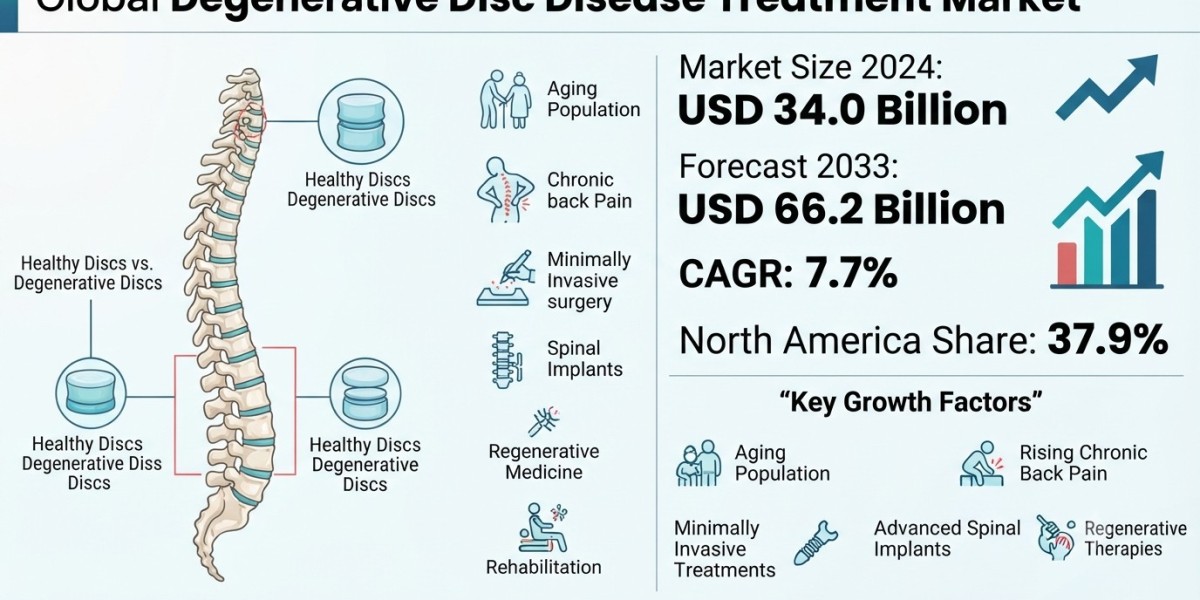
The Global Degenerative Disc Disease Treatment Market Size is expected to reach USD 34.0 billion in 2024 and is anticipated to expand to USD 66.2 billion by 2033 , registering a CAGR of 7.7% during the forecast period. Market growth is being supported by the increasing prevalence of age-related spinal degeneration, rising cases of chronic back and neck pain, improving access to diagnostic imaging, and continued development of pharmaceutical, minimally invasive, regenerative, and surgical treatment options.
Degenerative disc disease develops as spinal discs gradually lose hydration, elasticity, and structural strength, potentially causing pain, reduced mobility, nerve compression, and functional limitations. Although disc degeneration can occur naturally with aging, symptoms severe enough to require medical intervention create demand across pain management, physical therapy, medication, interventional procedures, and spinal surgery. Healthcare providers are increasingly highlighting treatment pathways that combine symptom management with mobility preservation and improved quality of life.
The market is also evolving as clinical strategies move toward personalized and less invasive care. Physicians may begin with conservative approaches such as physical therapy, anti-inflammatory medications, activity modification, and pain management before progressing toward injections, minimally invasive procedures, disc replacement, spinal fusion, or emerging regenerative therapies. Advances in imaging, surgical navigation, implant technologies, and biological research are further widening treatment possibilities.
? Looking for Specific Data? Get a Free Customized Sample:
https://dimensionmarketresearch.com/request-sample/degenerative-disc-disease-treatment-market/
Market Overview
Degenerative disc disease treatment represents a broad healthcare market encompassing therapies and procedures used to manage spinal disc deterioration and associated symptoms. Treatment requirements vary significantly according to patient age, severity of degeneration, location of affected discs, neurological involvement, lifestyle, and response to previous interventions.
The projected increase from USD 34.0 billion in 2024 to USD 66.2 billion by 2033 reflects sustained demand for therapies addressing chronic spinal disorders. At 7.7% CAGR highlights continued expansion as aging populations, sedentary lifestyles, obesity, occupational strain, and improved diagnosis contribute to a larger treatment population.
Important market characteristics include:
2024 market value: USD 34.0 billion
2033 forecast value: USD 66.2 billion
Forecast CAGR: 7.7%
North America share: 37.9% in 2024
Aging populations are expanding treatment demand
Minimally invasive procedures are gaining importance
Personalized spinal care is becoming more prominent
The treatment pathway generally depends on disease progression. Early-stage patients may primarily require physical rehabilitation and pharmacological management, while patients experiencing persistent pain, spinal instability, or nerve compression may require interventional or surgical procedures.
Key Findings
The Degenerative Disc Disease Treatment Market is developing around several structural healthcare trends that are expected to influence demand through 2033.
Market revenue is projected to nearly double by 2033
North America holds 37.9% market share in 2024
Aging remains a fundamental demand driver
Chronic back pain supports long-term treatment demand
Minimally invasive procedures continue gaining adoption
Advanced implants are improving surgical treatment options
Regenerative approaches represent an emerging opportunity
Healthcare systems are increasingly focused on reducing pain, restoring mobility, minimizing hospitalization, and accelerating patient recovery. Consequently, treatment innovation is increasingly directed toward solutions that combine clinical effectiveness with lower procedure-related burden.
Market Dynamics
The market is influenced by demographic change, clinical innovation, healthcare expenditure, reimbursement conditions, treatment accessibility, and patient preference. Growing awareness of spinal health and earlier diagnosis are supporting treatment initiation, while increasing availability of specialized spine centers is expanding access to advanced procedures.
At the same time, market development can be constrained by the cost of advanced surgical procedures, variability in treatment outcomes, reimbursement complexity, and the need for long-term clinical validation of emerging therapies. These factors create a market environment in which established treatments coexist with rapidly evolving technologies.
Growth Drivers
Rising Aging Population
Age remains one of the strongest factors associated with spinal disc degeneration. As populations live longer, healthcare systems are treating more patients experiencing chronic musculoskeletal disorders, including lumbar and cervical disc degeneration. Older adults may experience progressive disc dehydration, loss of disc height, spinal stiffness, and associated nerve-related symptoms.
The growing elderly population is therefore expected to sustain demand for both conservative and advanced treatment options.
Aging increases the prevalence of spinal degeneration
Longer life expectancy increases lifetime treatment requirements
Mobility preservation is becoming a healthcare priority
Older patients require customized treatment pathways
Increasing Prevalence of Chronic Back Pain
Chronic back and neck pain represents major reasons patients seek medical evaluation and long-term treatment. Degenerative changes in spinal discs may contribute to recurring discomfort, reduced workplace productivity, movement restrictions, and declining quality of life.
Greater awareness of chronic pain management is encouraging patients to seek earlier diagnosis and structured care. This expands opportunities for rehabilitation providers, pain specialists, orthopedic specialists, neurosurgeons, and manufacturers of spinal treatment technologies.
Expansion of Minimally Invasive Treatments
Minimally invasive spine procedures are gaining interest because they may reduce tissue disruption, recovery periods, blood loss, and hospitalization compared with more extensive surgical approaches. Advances in imaging, navigation, instrumentation, and specialized surgical techniques are strengthening adoption.
These approaches are especially relevant where patients require intervention but seek faster recovery and reduced procedure-related burden.
Market Challenges
High Treatment Costs
Advanced spinal procedures can involve significant costs related to implants, operating facilities, imaging, hospitalization, specialist care, and postoperative rehabilitation. Affordability therefore remains a challenge in markets where insurance coverage is limited or reimbursement policies vary.
Advanced spinal procedures can require high expenditure
Implant costs may limit treatment affordability
Reimbursement varies across healthcare systems
Postoperative rehabilitation adds further costs
Variability in Treatment Outcomes
Degenerative disc disease can present differently between patients, making treatment selection complex. Some patients respond effectively to conservative care, while others continue experiencing symptoms despite medication, rehabilitation, or surgery.
This variation increases the importance of precise diagnosis, appropriate patient selection, long-term follow-up, and evidence-based clinical decision-making.
Market Trends
Growing Adoption of Regenerative Therapies
Regenerative medicine is emerging as an important research area within degenerative disc disease treatment. Researchers and healthcare developers are exploring biological therapies intended to restore or preserve disc function rather than just addressing symptoms.
Cell-based therapies, biologics, tissue engineering, and growth-factor approaches may create future opportunities if supported by sufficient clinical evidence and regulatory approvals.
Shift Toward Motion-Preserving Technologies
Traditional spinal fusion remains an important treatment option, but motion-preserving technologies are attracting increasing attention. Artificial disc replacement and advanced implant designs seek to maintain greater spinal movement while addressing damaged discs.
Artificial disc replacement is gaining clinical attention
Motion preservation may support patient mobility
Implant design continues to advance
Personalized device selection is expanding
Integration of Digital and Image-Guided Surgery
Digital technologies are influencing spinal treatment through navigation systems, robotic assistance, preoperative planning, advanced imaging, and data-supported surgical decision-making. Such technologies can help improve procedural precision and support more standardized workflows.
Market Segmentation Overview
The Degenerative Disc Disease Treatment Market can be evaluated across treatment type, disease location, end user, and related care settings. Understanding these segments helps identify where demand, innovation, and investment are developing most strongly.
By Treatment Type
Treatment options generally include conservative therapy, medication, interventional procedures, and surgical management.
Physical therapy supports mobility and pain reduction
Medications remain important for symptom management
Injections serve selected pain-management needs
Disc replacement supports motion-preserving treatment
Spinal fusion remains important for advanced disease
Conservative treatment generally represents the first stage of management. Surgical approaches become more relevant when persistent pain, neurological symptoms, structural instability, or reduced functionality remain despite non-surgical care.
By Disease Location
Degenerative disc disease commonly affects the lumbar and cervical regions of the spine. Lumbar degeneration frequently contributes to lower-back symptoms, while cervical degeneration can affect the neck and may involve upper-extremity neurological symptoms.
Treatment approaches vary based on anatomical location, severity, patient characteristics, and the presence of nerve compression.
By End User
Hospitals, specialty clinics, ambulatory surgical centers, rehabilitation providers, and pain-management centers contribute to the treatment ecosystem.
Specialized spine and orthopedic centers are gaining importance because complex cases increasingly require multidisciplinary evaluation involving surgeons, pain specialists, rehabilitation professionals, and imaging specialists.
Purchase the report for comprehensive details:
https://dimensionmarketresearch.com/checkout/degenerative-disc-disease-treatment-market/
Regional Analysis
North America
North America is projected to dominate the Global Degenerative Disc Disease Treatment Market with 37.9% of market share in 2024 . Regional leadership is supported by a substantial aging population, high prevalence of spinal disorders, advanced medical infrastructure, widespread availability of imaging technologies, and strong access to specialized orthopedic and neurological care.
The United States and Canada represent important treatment markets because a significant proportion of their aging populations experience symptoms associated with spinal degeneration. Growing demand for effective treatment modalities is supporting the adoption of medications, rehabilitation programs, pain-management procedures, spinal implants, and minimally invasive surgeries.
Additional regional growth factors include:
North America holds 37.9% market share in 2024
Advanced spinal care supports treatment adoption
Aging populations increase patient volumes
Specialist infrastructure supports complex procedures
Minimally invasive techniques are increasingly used
Europe
Europe represents another significant market, supported by aging demographics, developed healthcare infrastructure, and increasing management of chronic musculoskeletal disorders. Demand for evidence-based treatment and rehabilitation is supporting adoption across major healthcare systems.
Asia-Pacific
Asia-Pacific presents considerable long-term growth potential as healthcare access expands, urban populations age, and awareness of spinal health improves. Growing hospital networks and increasing specialist availability are expected to support advanced diagnosis and treatment.
Competitive Landscape
The competitive landscape includes pharmaceutical companies, medical device manufacturers, spine implant developers, regenerative medicine companies, surgical technology providers, and healthcare organizations. Competition increasingly centers on treatment effectiveness, patient recovery, minimally invasive capabilities, implant performance, procedural accuracy, and long-term clinical outcomes.
Companies are focusing on product innovation, clinical development, improved implant materials, biological solutions, strategic partnerships, and technology integration. The growing importance of personalized spinal care is also encouraging development of solutions tailored to patient anatomy and disease severity.
Key competitive priorities include:
Improving clinical treatment outcomes
Developing less invasive solutions
Advancing spinal implant technologies
Expanding regenerative medicine research
Improving surgical precision and navigation
Strengthening specialist treatment portfolios
Future Market Outlook
The Degenerative Disc Disease Treatment Market is expected to maintain steady expansion through 2033 as demographic and clinical trends continue supporting demand. The projected market increase to USD 66.2 billion by 2033 indicates substantial opportunities across pharmaceuticals, medical devices, rehabilitation, surgical technologies, and emerging regenerative treatments.
Future development is likely to focus increasingly on prevention of disease progression, personalized treatment selection, motion preservation, minimally invasive interventions, and biological repair. Healthcare providers may also place greater emphasis on combining imaging, patient data, rehabilitation, and procedural technologies to develop more integrated treatment pathways.
Market value may reach USD 66.2 billion by 2033
Personalized spinal care will become increasingly relevant
Regenerative medicine may create new treatment pathways
Minimally invasive approaches should expand further
Digital surgical technologies will influence future care
Frequently Asked Questions
1. What is the Degenerative Disc Disease Treatment Market size in 2024?
The Global Degenerative Disc Disease Treatment Market is expected to reach USD 34.0 billion in 2024 , supported by increasing spinal degeneration cases, aging populations, expanding diagnosis, and rising demand for conservative and surgical treatments.
2. What will the market be worth by 2033?
The market is projected to reach approximately USD 66.2 billion by 2033 , expanding at a compound annual growth rate of 7.7% over the forecast period.
3. Which region dominates the market?
North America is expected to dominate with 37.9% of the market in 2024 , supported by advanced healthcare infrastructure, an aging population, high treatment accessibility, and widespread availability of specialized spinal care.
4. What factors are driving market growth?
Growth is primarily supported by aging populations, increasing chronic back pain, improved diagnosis, greater adoption of minimally invasive procedures, advancements in spinal implants, and continued development of regenerative treatment approaches.
5. What are the biggest future opportunities in this market?
Major opportunities include regenerative medicine, artificial disc replacement, biological therapies, minimally invasive surgery, personalized spinal treatment, robotic assistance, navigation technologies, and advanced implants designed to preserve mobility.
Summary of Key Insights
The Global Degenerative Disc Disease Treatment Market is positioned for sustained expansion as spinal degeneration becomes increasingly important within aging and chronic pain populations. From USD 34.0 billion in 2024 , the market is forecast to reach USD 66.2 billion by 2033 , representing a 7.7% CAGR .
North America is expected to retain a prominent position with a 37.9% share in 2024 , while opportunities are expanding across other regions as healthcare infrastructure and specialized spinal care improve. Market evolution will increasingly be shaped by minimally invasive treatments, motion-preserving implants, regenerative medicine, digital surgery, and personalized care.
2024 market size: USD 34.0 billion
2033 forecast: USD 66.2 billion
Forecast CAGR: 7.7%
North America share: 37.9%
Aging populations remain a major demand driver
Minimally invasive treatments offer strong opportunities
Regenerative medicine could reshape future treatment
As healthcare systems increasingly prioritize mobility, quality of life, reduced recovery times, and long-term management of chronic spinal conditions, innovation across pharmaceuticals, medical devices, surgery, and regenerative treatments is expected to remain central to the market's development through 2033.


