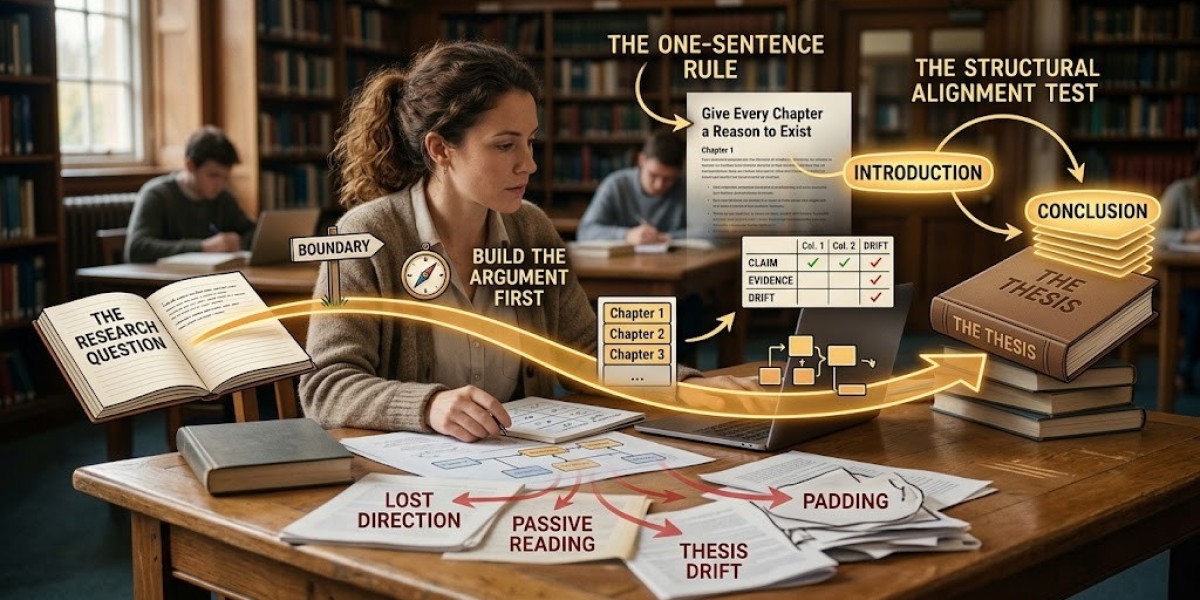
There's a particular moment every supervisor recognises before the student does. The chapters have quietly ballooned, the literature review refuses to end, and the research question sitting politely in the introduction has somehow drifted away from everything written after it. There's no shortage of material. The trouble is, none of it seems to be going anywhere in particular.
It's a maddening stage to hit, mostly because it tends to show up just as the research is genuinely going well. You've found stronger sources, spotted a disagreement you didn't see coming, maybe even changed your mind about something. That's not a sign you've gone wrong that's what proper research looks like. The real skill is turning those discoveries into a sharper argument, rather than letting them tug your thesis off in three directions at once.
A Research Question Is a Boundary, Not Just a Starting Point
A research question isn't just there to announce your topic. Its real job is to draw a line around it.
That becomes obvious the moment you start reading seriously. Ask a question about the effect of a policy, and within a week you're knee-deep in its history, its politics, how it was implemented, how the public reacted, and its knock-on effects on everything from housing to healthcare. All of it might be relevant in some loose sense. Very little of it deserves equal space in your thesis.
Before you build anything, sit with what the question is genuinely asking of you. Are you meant to explain something, evaluate it, compare two things, investigate a gap, or establish a claim? What do the key terms actually mean? What timeframe, population, case study or evidence base are you realistically working within?
Then have a go at answering it. Badly, if necessary.
That answer will almost certainly change as you go and that's fine. A rough working answer gives you something to measure new evidence against. Without one, "research" quietly turns into an endless scroll through Google Scholar, because there's no moment where you can honestly say, "this belongs in my argument" or "this doesn't."
The tightest research questions aren't always the narrowest ones. They're the ones you can actually answer.
Build the Argument Before You Build the Chapters
It's tempting to start with a list of chapter titles, because a neat contents page makes 80,000 words feel briefly manageable. The problem arrives later, when those titles need filling in.
A chapter labelled "Background" has a horrible habit of swallowing twenty-five pages. A literature review can turn into a chronological tour of everyone who's ever written on the subject. A methodology chapter can describe every procedure in painstaking detail without ever explaining why any of it matters to your question.
Start with the argument instead.
What do you currently think the evidence is telling you? What would a sceptical reader need to be shown before they'd accept that conclusion? Which of those claims rest on others coming first?
Those answers are what actually shape a thesis not a template you found online.
A chapter earns its place by doing a job for the argument, not simply by being loosely on-topic. That might mean setting out a theoretical position, working through a body of evidence, stress-testing a rival explanation, or pulling together findings that have, until now, sat in separate corners. The exact shape will depend on your discipline and your institution's expectations, but the underlying test stays the same: could a reader explain why the thesis moves from this chapter to the next?
Know When Research Is Helping - and When It's Just Piling Up
Every serious research project has a stretch where reading starts to feel suspiciously easy.
You find a paper. It cites something useful. That leads to another paper. You take a note. Your bibliography grows nicely. It feels productive and yet the actual argument hasn't moved an inch in days.
The issue usually isn't that you've read too much. It's that the reading has stopped being led by a question and started being led by curiosity, which is a lovely trait in a person and a genuine liability in a thesis deadline.
Every source in your working pile should be doing a specific job: offering evidence, challenging an assumption, providing a rival interpretation, or exposing a weak spot in existing work. Once you know which job a source is doing, writing about it gets dramatically easier.
This is also where it's worth being honest about the different kinds of help on offer. Anyone searching around for a thesis writing service UK will find a real mix of options, and it's worth knowing the difference between them. Legitimate academic support supervision, structured feedback, a second pair of eyes on your argument, help with referencing or clarity is genuinely useful and widely used. Having someone else produce work for submission is a different matter entirely, and not one worth the risk. Keeping the thinking your own is what allows the finished thesis to actually reflect the research you did and the conclusions you reached, which, awkwardly, is the entire point of doing a thesis in the first place.
Good research was never measured by volume. Eventually you have to stop collecting and start deciding what the evidence actually lets you claim.
Give Every Chapter a Reason to Exist
Once the shape of the argument is starting to settle, turn it into a working structure not a rigid one, just something to steer by.
Don't try to script every paragraph this early; a thesis moves too much for that to survive contact with reality. Instead, give each chapter a single clear job. A rough plan might read:
- Lay out the central debate and name the gap your research is addressing
- Explain the approach you took and why it fits the question
- Work through the first major strand of evidence
- Test that evidence against a plausible alternative reading
- Bring it together and say plainly what it establishes
The One-Sentence Rule: Write a single sentence stating each chapter's precise purpose directly underneath its heading. Whenever word count creeps, hold the new material up against that single sentence. If it doesn't directly serve that job, it is padding no matter how well-written it is.
More often than not, the culprit isn't bad material. It's good material doing the wrong job in the wrong chapter. That's a hard thing to accept after a week spent reading it but selecting what stays out is as much a part of the academic work as the writing itself.
Learn to Spot the Drift Before It Spots You
Thesis drift rarely arrives with any warning.
It happens through a string of entirely reasonable decisions. A bit more context here. A related debate that "needs" explaining there. A source that challenges your original reading, so naturally you go and investigate it properly. None of these choices looks wrong in isolation. Add them up over three months, though, and the centre of gravity of your thesis has moved while the structure around it hasn't caught up.
Sometimes that shift is exactly right. If the evidence genuinely changed your thinking, the thesis should change too. The trouble starts when you pretend nothing's moved.
Go back and reread your introduction once the main body has some real weight to it. Does it still describe the thesis you're actually writing? Look at where your conclusion is heading is it answering your original question, or a newer one that snuck in somewhere around chapter three?
Repetition is another tell. If two chapters are quietly making the same point, that's rarely an information problem it's a structural one, and a much better use of an afternoon than opening another database search.
Test the Logic Before You Polish the Prose
A beautifully written chapter can still be sitting in entirely the wrong place.
Before agonising over sentence-level polish, write one line stating what each chapter actually establishes, then read those lines in order. You should be able to watch the reasoning build not just wander from one loosely related topic to the next.
| Structural Component | Core Purpose | Indicator of Drift |
|---|---|---|
| Academic Claim | Defines the explicit argument or point being established | The claim responds to a new tangent rather than the research question |
| Supporting Evidence | Supplies direct data, references, or proof for the claim | Sources pile up without moving the argument forward |
| Critical Interpretation | Connects evidence back to the core research question | The section summarises external findings without explaining their relevance |
Then interrogate the trickier sections directly:
- What exactly am I claiming here?
- What evidence lets me claim it?
- What would a fair alternative reading look like?
- How does this actually move me closer to answering the research question?
These questions earn their keep most when a chapter feels thin. Nine times out of ten, the fix isn't more evidence it's more interpretation joining the evidence you already have to the argument you're making. And it's always worth checking your structure against your own institution's expectations before you settle on it, since methodology, chapter order and presentation norms genuinely vary between subjects.
Keep the Thread Running From First Page to Last
A thesis is allowed to change its mind. Frankly, one that never makes you reconsider anything was probably too narrow to begin with.
The Structural Alignment Test: Your introduction and conclusion must act as exact bookends. If your conclusion answers a fundamentally different question than the introduction posed, you haven't written a bad draft you've written an outdated introduction. Update the frame to match the final argument.
The goal was never to defend your first idea to the death. It's to make sure every genuine shift in your thinking is reflected honestly in the argument that ends up on the page.
When a thesis starts feeling unmanageable, going back to the research question usually does more good than another hour on Google Scholar. Ask, plainly, what the thesis is trying to establish. Then look chapter by chapter and decide which ones are actually helping it get there.
Some material stays. Some gets moved. Some even good material has to go. That's not wasted effort. That's what turns a pile of research into a thesis.
By the final page, a reader shouldn't have to do any reconstruction work of their own. They should be able to follow the question, see why the evidence matters, watch the argument develop, and understand exactly how the conclusion was earned. That sense of direction, more than word count or reference list, is what makes a long piece of writing feel like one coherent piece of work rather than a very thick stack of research that happens to be bound together.