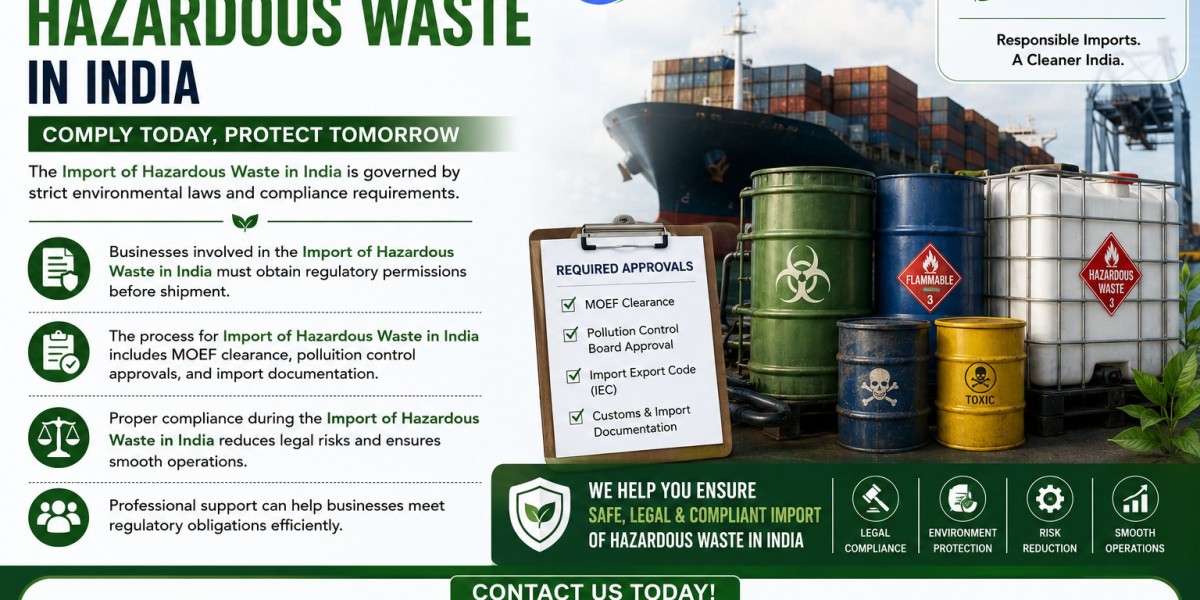
Materials such as used oil, lead scrap, e-waste components, and waste tires carry real environmental and health risks if mishandled. Before any such consignment can legally enter the country for recycling, reprocessing, or reuse, the importer must secure sign-off from the Ministry of Environment, Forest and Climate Change (MoEFCC). This approval — widely known as the MoEF certificate — isn't a rubber-stamp formality. Skip it, and you risk a seized shipment, financial penalties, or being barred from future imports altogether.
This article walks through what the MoEF certificate actually covers, which businesses need it, how the approval process unfolds, and how it connects to Pollution Control Board clearances.
The Legal Backbone: Why This Approval Exists
The requirement isn't arbitrary. It stems from the Hazardous and Other Wastes (Management and Transboundary Movement) Rules, 2016, and from India's commitments under the Basel Convention — the global treaty governing how hazardous waste crosses international borders and how it must eventually be disposed of responsibly. In short, the MoEFCC is the gatekeeper deciding whether a specific shipment of regulated waste is allowed into the country at all.
Meet the HSMD: The Division Behind the Paperwork
Anyone who has dealt with a waste-import file has likely seen the acronym "HSMD" stamped across correspondence and notifications. It stands for the Hazardous Substances Management Division, the unit within the Ministry tasked with overseeing chemical safety and hazardous-substance management nationwide. Its job goes beyond issuing permits — it also represents India internationally under four major agreements: the Basel Convention (hazardous waste movement), the Rotterdam Convention (prior consent for hazardous chemicals and pesticides), the Stockholm Convention (persistent organic pollutants), and the Minamata Convention (mercury). Every file number you see prefixed "HSMD" originates from this office.
Does Your Import Actually Need MoEF Sign-Off?
Not every imported material triggers this requirement, but a substantial slice of industrially valuable waste does. Businesses bringing in lead scrap, battery scrap, waste tires and rubber scrap, used oil, or electrical and electronic assemblies must obtain MoEF permission and clearly demonstrate what the material will be used for once it lands.
The applicable Schedule III framework breaks waste into categories:
- Part A materials need both the exporting country's prior informed consent and MoEF approval.
- Part B ("other wastes") also needs MoEF sign-off, although the paperwork is comparatively lighter.
- Part C covers unlisted materials that still show hazardous properties — these require written MoEF clearance regardless.
- Part D materials are low-risk enough to move without any Ministry permission.
Liquid waste — used oil, spent solvents, waste catalysts, and similar residues — almost always falls into a regulated bracket. Because of the contamination risk involved, these typically can't even be submitted for review without a chemical composition report from an accredited testing laboratory.
How the Clearance Process Actually Works
While exact documentation shifts depending on the waste category, the broad sequence looks like this:
- File the application. The importer submits the prescribed form (commonly Form 5) along with a justification for the import, a lab-verified composition report, and a process flow chart showing the pollution-control setup at the receiving site.
- Loop in the State Pollution Control Board. The copy goes to the relevant SPCB for acknowledgment, which then becomes part of the MoEF submission.
- Ministry review. The application is examined alongside SPCB feedback before any decision is made.
- Approval. Once satisfied, the Ministry generally issues permission within about sixty days, contingent on the importer meeting stated conditions.
- Notification to enforcement bodies. Approved permissions are shared with port and customs authorities, the CPCB, and the SPCB so compliance can be verified at every checkpoint.
After approval, ongoing obligations kick in too — importers must keep records in the prescribed Form 3 and file an annual return with their SPCB.
Where Pollution Control Board Clearance Fits In
MoEF clearance and Pollution Control Board clearance run in parallel, not as substitutes for one another. The MoEF certificate authorizes the import transaction itself. The SPCB/CPCB clearance — usually a Consent to Operate plus an Authorization under the Hazardous and Other Wastes Rules — confirms that your facility is actually built to store, treat, or dispose of the waste safely. In practice, your MoEF application will ask for your current SPCB Authorization number and its validity, so a lapsed or missing Authorization can stall the entire import approval, no matter how complete everything else is.
Getting the Paperwork Right the First Time
Most rejections and delays trace back to avoidable gaps: incomplete lab reports, a missing SPCB acknowledgment, or an expired Authorization. Since non-compliant shipments can sit held at port while clearance is sorted out, accuracy on the first submission is worth far more than speed later. For businesses that would rather not navigate the HSMD, SPCB, and Ministry review chain alone, working with an experienced compliance partner can shorten the runway from application to approved import.