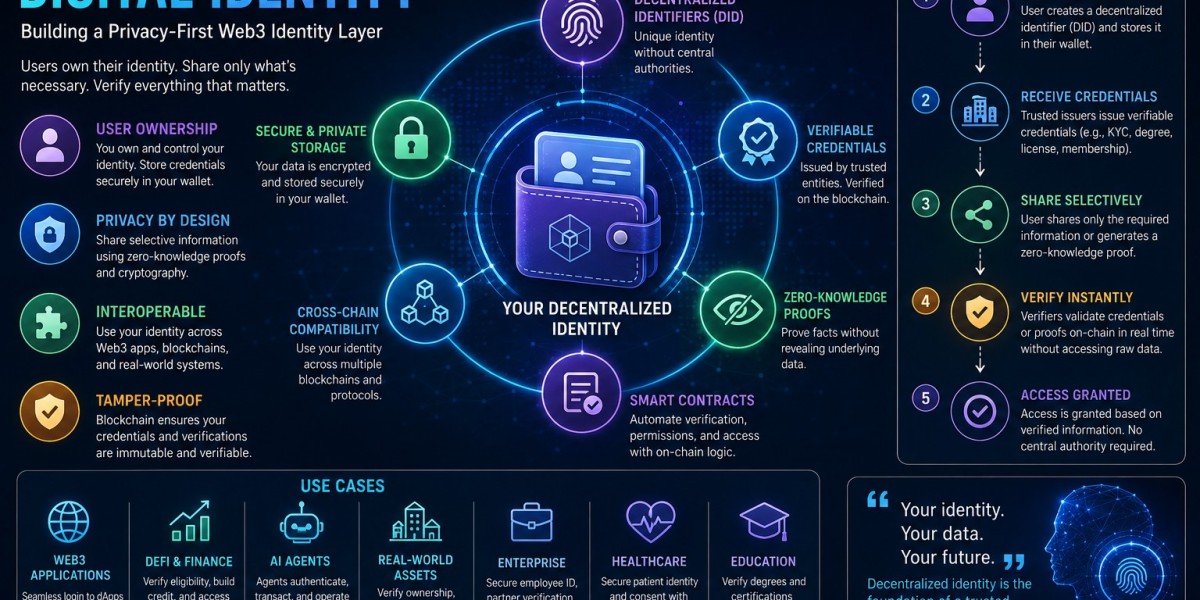
Digital identity is becoming one of the most important infrastructure challenges of the internet. As users interact with financial platforms, decentralized applications, AI agents, online communities, gaming ecosystems, and enterprise services, traditional identity systems are increasingly being challenged by concerns around privacy, data ownership, security, and interoperability.
In 2026, blockchain-powered digital identity is evolving beyond simple wallet addresses. New identity architectures are combining decentralized identifiers, verifiable credentials, zero-knowledge proofs, smart contracts, and privacy-preserving technologies to give users greater control over how their digital information is shared.
For organizations exploring this transformation, partnering with a specialized Blockchain Development Company can help create secure and scalable identity infrastructure for Web3 and enterprise applications.
What Is Blockchain-Based Digital Identity?
Blockchain-based digital identity is an identity framework that uses decentralized technologies to manage authentication, credentials, permissions, and reputation.
Instead of storing all personal information inside centralized databases, users can control digital credentials through decentralized wallets or identity systems.
A blockchain identity architecture can support:
Decentralized identifiers
Verifiable credentials
Digital certificates
Reputation systems
Access management
Privacy-preserving authentication
Cross-platform identity
Blockchain-based authorization
Zero-knowledge verification
The goal is not necessarily to put personal information directly on a blockchain. Instead, blockchain can provide a trusted infrastructure for verifying claims while minimizing unnecessary data exposure.
Why Digital Identity Is Changing in 2026
Traditional digital identity systems often require users to create accounts repeatedly across different platforms.
This creates several problems:
Repeated identity verification
Centralized data storage
Password dependency
Data breaches
Limited user control
Poor interoperability
Excessive collection of personal information
Blockchain-based identity introduces a different model.
A user can potentially prove a specific fact without revealing unrelated information.
For example, instead of sharing an entire identity document to prove that someone meets an age requirement, a privacy-preserving identity system could verify the required attribute without exposing the user's complete personal profile.
Verifiable Credentials and User-Owned Identity
Verifiable credentials are becoming a major component of decentralized identity.
A credential could represent information such as:
Educational qualifications
Professional certifications
Memberships
Licenses
Business credentials
Reputation
Eligibility
Ownership rights
The issuer creates the credential, the user controls it, and an authorized application verifies it.
This creates a flexible identity model where credentials can move with the user instead of remaining locked inside a single platform.
A blockchain developer company can build credential-management infrastructure that connects wallets, smart contracts, decentralized applications, and verification services.
Zero-Knowledge Proofs and Private Authentication
Privacy is one of the strongest reasons blockchain identity is gaining attention.
Zero-knowledge proofs allow users to demonstrate that a particular condition is true without revealing all underlying information.
For example, a system could potentially verify:
“User meets the required eligibility criteria.”
without exposing every piece of information contained in the user's identity record.
This approach can reduce unnecessary data sharing while improving user privacy.
A blockchain smart contract development agency can integrate zero-knowledge verification into applications that require secure access, compliance checks, or privacy-sensitive transactions.
Blockchain Identity for Web3 Applications
Web3 applications frequently use wallets as a form of authentication. However, a wallet address alone does not provide a complete identity system.
Future Web3 applications can combine wallet authentication with verifiable credentials and decentralized reputation.
This could allow users to maintain a portable identity across:
DeFi platforms
NFT marketplaces
Gaming applications
DAOs
Social networks
Metaverse platforms
Developer communities
Decentralized marketplaces
A Web3 Development Agency can design identity systems that work across multiple applications while minimizing unnecessary user friction.
Identity for AI Agents
One of the most interesting developments in 2026 is the emergence of AI agents capable of performing tasks autonomously.
AI agents may interact with financial platforms, APIs, blockchain networks, marketplaces, and other software systems.
This creates an important question:
How does an application know which AI agent it is interacting with?
Blockchain identity can potentially provide agents with verifiable credentials and cryptographic identities.
An AI agent could have:
A cryptographic identity
Permission credentials
Spending limits
Reputation records
Service authorizations
Transaction history
Smart-contract-controlled permissions
This creates an emerging concept of machine identity.
Instead of identifying only humans, blockchain identity infrastructure can potentially authenticate autonomous software entities as well.
Digital Identity and Decentralized Finance
Identity can also transform decentralized finance.
Many financial applications require users to meet specific eligibility or compliance requirements. Blockchain identity could allow users to present verified credentials without repeatedly submitting the same information to every platform.
Potential applications include:
Permissioned DeFi
Institutional finance
Credit systems
Tokenized assets
Cross-border payments
Lending platforms
Compliance-aware wallets
Financial credentialing
A Decentralized Exchange Development Company can also incorporate identity and permission layers into trading platforms where specific user verification or jurisdictional requirements apply.
Identity and Real-World Assets
Tokenized real-world assets require more than token infrastructure.
A real-world asset ecosystem may need to determine:
Who owns an asset
Who can transfer it
Who is eligible to purchase it
Which credentials are required
Whether a transaction meets specific rules
Blockchain identity can connect verified credentials with tokenized assets and smart contracts.
For example, a smart contract could require a valid credential before allowing a specific asset transfer.
This creates the foundation for programmable ownership and compliance.
Enterprise Blockchain Identity
Enterprises can also benefit from decentralized identity infrastructure.
Businesses often manage identities across employees, suppliers, customers, partners, contractors, and applications.
A blockchain identity architecture can provide a common verification layer across these participants.
Potential enterprise applications include:
Employee credentials
Supplier verification
Digital certificates
Access control
Supply-chain authorization
Partner authentication
Compliance verification
Document verification
A Blockchain Consulting Company can help organizations determine which identity information should remain off-chain and which verification data can interact with blockchain infrastructure.
Blockchain Identity and Cryptocurrency Development
Cryptocurrency platforms increasingly require more sophisticated authentication and authorization mechanisms.
Wallets, exchanges, payment applications, and token platforms can integrate decentralized identity with transaction permissions.
For example, a digital wallet could support different authorization levels depending on the user's verified credentials.
A cryptocurrency development project can therefore combine:
Wallet infrastructure
Identity management
Smart contracts
Transaction monitoring
Credential verification
Multi-chain support
This creates a more flexible architecture than relying solely on passwords or wallet addresses.
The Role of Interoperability
Identity becomes significantly more useful when it works across different blockchain networks.
A user should not necessarily need a separate identity for every ecosystem.
Interoperability can enable credentials and permissions to interact with applications across multiple chains.
A blockchain technology development company can design identity infrastructure capable of connecting different blockchain environments, wallets, APIs, and enterprise systems.
This can help create a more unified Web3 experience.
Building a Blockchain Digital Identity Platform
Organizations developing blockchain identity solutions should approach the project systematically.
1. Define Identity Requirements
Determine what identities, credentials, permissions, and verification processes the application needs.
2. Select the Blockchain Architecture
Choose public, private, Layer 2, or hybrid infrastructure based on scalability, privacy, and business requirements.
3. Design Credential Infrastructure
Determine how credentials are issued, stored, presented, revoked, and verified.
4. Develop Smart Contracts
Create smart contracts for permissions, authorization, credential verification, and identity-related workflows where appropriate.
5. Implement Privacy Technologies
Use cryptographic techniques such as zero-knowledge proofs when privacy-preserving verification is required.
6. Build the User Experience
Create wallets, dashboards, authentication interfaces, APIs, and verification workflows that make identity management simple.
7. Perform Security Testing
Test smart contracts, authentication mechanisms, cryptographic processes, APIs, and access-control systems.
8. Deploy and Monitor
After deployment, continuously monitor identity events, permissions, suspicious activity, and system performance.
Why Businesses Need Specialized Development Expertise
Blockchain identity combines several technical disciplines.
Projects may require expertise in blockchain architecture, cryptography, smart contracts, APIs, application development, security, and Web3 infrastructure.
A Blockchain Development Agency can help businesses transform identity concepts into production-ready platforms.
Similarly, a Web3 Development Company can integrate decentralized identity into wallets, dApps, marketplaces, DAOs, and other decentralized ecosystems.
For projects combining blockchain with traditional applications, a Web Development Agency or Web Development Company can help connect identity infrastructure with existing digital platforms.
How HyprForge Can Support Blockchain Identity Innovation
HyprForge can be positioned as a technology partner for organizations exploring blockchain-based identity, Web3 applications, smart contracts, digital assets, and decentralized infrastructure.
From blockchain architecture and identity workflows to application interfaces and smart contract development, businesses can build customized solutions based on their specific requirements.
Organizations searching for a bockchain app development company can explore blockchain-powered identity as part of a broader digital transformation strategy.
The Future of Digital Identity
The next generation of digital identity is likely to become more portable, programmable, privacy-focused, and user-controlled.
Instead of repeatedly creating accounts and handing personal information to centralized platforms, users could carry verified credentials across digital environments.
At the same time, autonomous AI agents will create a new category of machine identity requiring cryptographic authentication, permissions, reputation, and transaction controls.
Blockchain can provide the infrastructure required to make these systems interoperable and verifiable.
Conclusion
Blockchain-powered digital identity is becoming an important foundation for the next generation of Web3 and enterprise applications. By combining decentralized identifiers, verifiable credentials, zero-knowledge proofs, smart contracts, and interoperability, businesses can create identity systems that are more flexible and privacy-conscious.
The opportunity extends beyond human authentication. As AI agents, tokenized assets, decentralized finance, and cross-chain applications continue to evolve, identity will become an essential layer connecting people, organizations, assets, and autonomous software.
For businesses preparing for the future of digital identity, investing in secure blockchain infrastructure today can create the foundation for more trusted and user-centric digital ecosystems tomorrow.