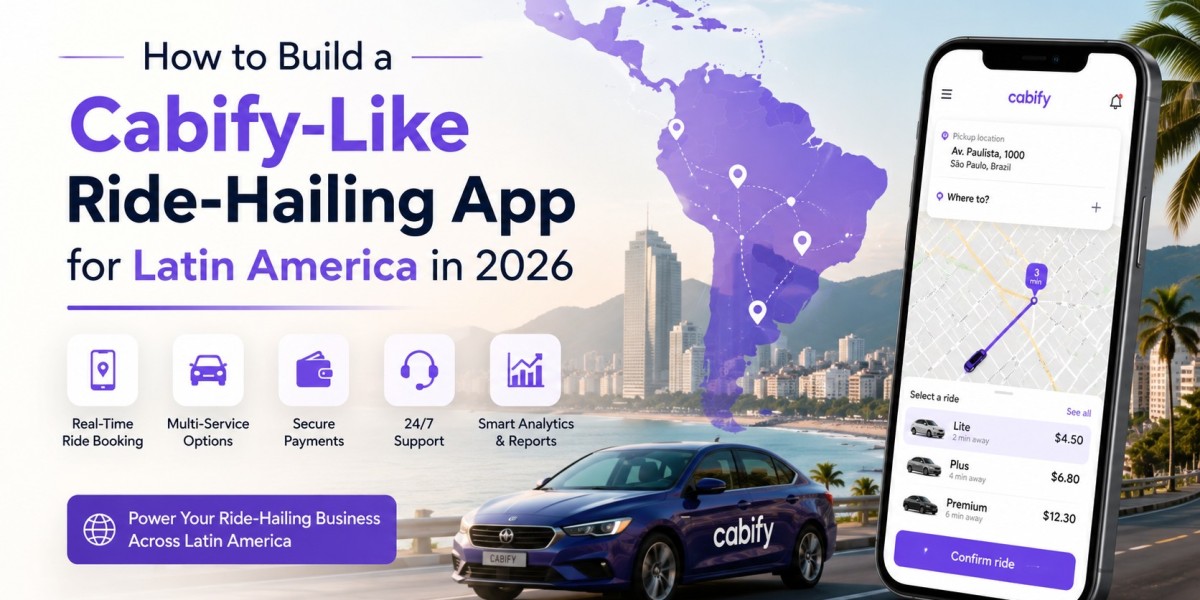
A lot of entrepreneurs enter the ride-hailing market with the same assumption: build an app, add GPS tracking, connect drivers with riders, and compete with existing platforms.
That is usually where the misunderstanding begins.
A ride-hailing business is not built around an app interface. The app is only the visible layer. Behind it is a complex operating system that manages driver supply, rider demand, payments, safety, pricing, customer support, and local regulations.
This is why building a Cabify-like platform for Latin America requires more than copying features. You need to understand the market, choose the right launch strategy, and build technology that supports the realities of local transportation.
For 2026, the opportunity is especially interesting in mid-sized Latin American cities where users often need more reliable, safer, and more locally adapted mobility options.
Why Latin America Is Still an Attractive Ride-Hailing Market
The biggest opportunity in Latin America is not simply competing on price.
Users are looking for platforms they can trust.
They want:
- Reliable pickups
- Transparent fares
- Safer rides
- Convenient payment options
- Better communication when something goes wrong
Companies that understand local behavior have an advantage over platforms that treat every market the same.
Several changes are creating new opportunities in 2026.
Smartphone Adoption Is Expanding Beyond Major Cities
Ride-hailing demand is no longer limited to capital cities.
Many secondary cities now have:
- Growing smartphone adoption
- Increasing digital payment usage
- Younger users comfortable with app-based services
This creates opportunities for focused mobility platforms.
Digital Payments Are Becoming More Important
Cash remains relevant across many Latin American markets, but digital payments continue to grow.
Users increasingly expect support for local payment methods such as:
- Mercado Pago
- Nequi
- Yape
- Daviplata
A platform that ignores local payment behavior creates unnecessary friction from the beginning.
Drivers Are Looking for Better Platforms
Driver supply is one of the biggest challenges in ride-hailing.
Many drivers are frustrated by:
- High commissions
- Limited earnings visibility
- Slow payout processes
A platform offering transparent earnings and better driver economics can use this as a competitive advantage.
The First Decision: Do Not Launch Everywhere
One of the most common mistakes in ride-hailing startups is trying to enter multiple countries immediately.
Latin America is not one single market.
Mexico, Colombia, Peru, Chile, and other countries have different:
- Regulations
- Payment habits
- Customer expectations
- Transportation environments
The smarter approach is usually a city-first strategy.
Choose one market where you can build density and understand operations.
For example:
- Guadalajara instead of Mexico City
- Barranquilla instead of Bogotá
The goal is not maximum geographic coverage.
The goal is proving that your platform can create a reliable transportation network.
Why a Single-City Launch of Cabify-Style App Makes Sense
A focused launch gives you better control over:
Driver Operations
You can understand:
- Where drivers are needed
- Which incentives work
- How demand changes throughout the day
Customer Experience
You can improve:
- Pickup times
- Pricing accuracy
- Support processes
Marketing Efficiency
Instead of competing everywhere, you can focus on local search demand:
- "best taxi app in [city]"
- “safe transportation app in [city]”
- “Uber alternative in [city]”
A smaller market with stronger execution is often more valuable than a large market with weak operations.
What a Cabify-Like MVP Actually Needs
Many founders make the mistake of building too many features too early.
A successful MVP is not about copying every feature from established platforms.
It is about building the systems needed to operate successfully.
Rider App: The Features That Matter
Real-Time Booking and Tracking
Users expect:
- Accurate pickup locations
- Driver tracking
- Estimated arrival times
Poor location accuracy immediately damages trust.
Transparent Pricing
Users want to understand the cost before confirming a ride.
Your platform should support:
- Fare estimates
- Clear pricing details
- Simple fee explanations
Local Payment Support
Payment flexibility is critical.
Support:
- Cash
- Cards
- Local digital wallets
The best payment experience is the one customers already understand.
Safety Features
Safety is part of the product experience.
Important capabilities include:
- Trip sharing
- Emergency assistance
- Driver verification
- Ride history
Ratings and Feedback
Feedback systems help maintain service quality and identify problems early.
Driver App: Where Marketplace Success Begins
Many startups focus heavily on riders and underestimate drivers.
That is a mistake.
Without reliable driver supply, the customer experience breaks down.
A driver app should include:
- Simple onboarding
- Document verification
- Earnings visibility
- Ride acceptance controls
- Performance tracking
- Flexible payouts
The best driver experience is not about adding more features.
It is about helping drivers earn efficiently.
The Backend Is Where the Real Product Exists
A polished mobile app cannot fix weak operations.
The backend determines how well the business performs.
A serious ride-hailing platform needs:
Dispatch Management
The system should efficiently match:
- Available drivers
- Rider requests
- Location conditions
Pricing Controls
You need flexibility around:
- Demand changes
- Promotions
- Regional pricing
Fraud Prevention
Ride-hailing platforms must monitor:
- Fake GPS activity
- Multiple accounts
- Promotion abuse
Admin Operations
Your team needs visibility into:
- Active rides
- Driver activity
- Customer complaints
- Payments
How Should You Choose the Right Development Approach
There is no single correct way to build a ride-hailing platform.
The right choice depends on your business goals and growth strategy.
White-Label Solution
Useful when speed matters.
Advantages:
- Faster launch
- Lower initial complexity
Limitations:
- Less differentiation
- Limited control
- Possible scaling challenges
Fully Custom Development
Better for companies building long-term technology ownership.
Advantages:
- Complete control
- Custom workflows
- Greater flexibility
Challenges:
- Longer development cycle
- More technical planning required
Hybrid Development Approach
For many startups, this is the practical middle ground.
Build your competitive advantage internally:
- Matching logic
- Pricing workflows
- Driver systems
- Safety features
Use existing services for:
- Maps
- Payment infrastructure
- Communication tools
This allows faster development without building everything from scratch.
Technology Stack for a Modern Ride-Hailing Platform
A typical 2026 stack may include:
Maps and Location
- Google Maps Platform
- Mapbox
Backend
Common choices:
- Node.js
- Go
- PostgreSQL
- Redis
Mobile Development
Popular options:
- React Native
- Flutter
Payments and Communication
Integrate providers that perform well in your target countries.
A payment system that works in one region may not provide the same experience across all Latin American markets.
Compliance Is a Product Requirement
Transportation businesses often underestimate regulation.
Compliance is not something to solve after launch.
You need to consider:
- Operating permissions
- Driver requirements
- Insurance
- Data protection
- Local transportation rules
For example: