
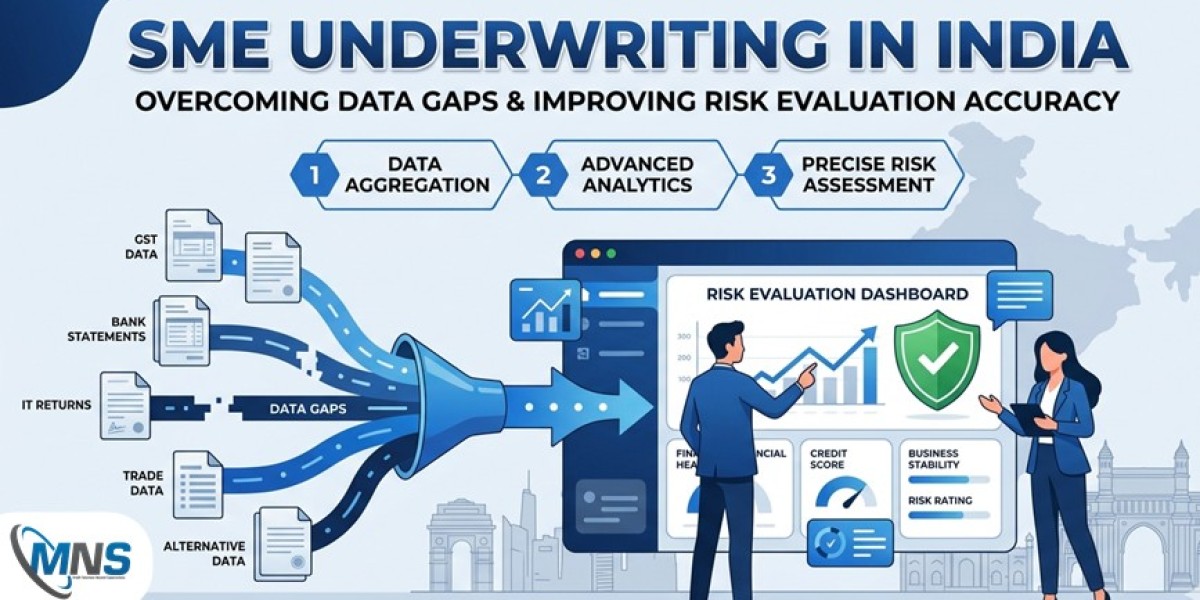
The Data Gap That Defines SME Lending in India
SME underwriting in India confronts a paradox that defines the sector's development challenge: the businesses most in need of credit are often the hardest to assess with conventional analytical tools. India's MSME sector — comprising tens of millions of enterprises that collectively employ the majority of the non-agricultural workforce and contribute substantially to GDP — is characterized by a degree of informality, documentation variability, and financial record inconsistency that makes traditional credit assessment frameworks inadequate for a large proportion of potential borrowers.
Many SMEs maintain financial records primarily for tax compliance rather than business management, resulting in statements that may underreport revenues, mix personal and business finances, and lack the accounting rigor that formal credit assessment requires. Credit bureau data is thin or absent for a significant portion of the SME population, particularly first-time borrowers and businesses in the informal economy. And the operational knowledge about an SME's actual business performance — its customer relationships, its order book, its supplier payment behavior, its real cash flows — is often not captured in any formal document at all.
This data gap is not a reason to decline credit to deserving SMEs. It is a challenge to build underwriting frameworks that can assess credit risk accurately with a different evidence base from the one that traditional models were designed for.
GST Data: The Most Underutilized SME Credit Signal
The introduction of the Goods and Services Tax regime has, as a secondary effect, created one of the most valuable credit assessment datasets available for Indian SMEs. GST filing data — particularly GSTR-1 (outward supply) and GSTR-3B (monthly summary) returns — provides a contemporary, government-verified record of a business's revenues, transaction volumes, and customer base that is independent of whatever financial statements the borrower may present.
For underwriters, GST data offers several critical advantages over financial statements alone. It is more current — filed monthly or quarterly rather than annually. It is harder to manipulate — government-verified rather than self-prepared. And it captures the full revenue picture, including transactions that might be omitted from informally prepared accounts. Cross-referencing stated revenues against GST filing data is one of the highest-value verification steps available in SME underwriting, immediately flagging the discrepancies that indicate either misrepresentation or informal revenue that may not be sustainable.
Bank Transaction Data Through the Account Aggregator Framework
India's Account Aggregator framework represents a structural breakthrough for SME credit assessment, enabling loans — with borrower consent — to access bank transaction data directly from banking institutions in a standardized, machine-readable format. This transaction-level data provides a real-time view of cash inflows and outflows, seasonal revenue patterns, expense structures, and financial management behavior that no conventional financial document can replicate.
For underwriters, bank transaction data enables cash flow-based credit assessment that is particularly well-suited to the SME context. Rather than relying on reported profit — which may be understated for tax purposes or distorted by accounting choices — cash flow analysis based on actual transaction data reveals the business's real financial capacity to service debt. This approach is both more accurate and more inclusive: it assesses creditworthiness on the basis of demonstrated financial behavior rather than documentary compliance, making credit accessible to businesses that are genuinely viable but conventionally undocumented.
Business Information Reports and Corporate Verification
Beyond financial data, accurate SME underwriting requires verification of the business entity itself — confirmation that the company or proprietorship is legitimately constituted, currently operational, and managed by individuals with clean corporate histories. Business Information Reports that consolidate MCA registry data, director history, payment behavior from trade creditor sources, and litigation records provide this corporate verification in a single, structured format that manual research across multiple sources could not replicate at scale.
Director history analysis is particularly valuable in the SME context, where key individuals may be associated with multiple business ventures across their careers. A promoter who has previously been involved in businesses that failed or were struck off under adverse circumstances carries a risk profile that is material to any credit assessment, regardless of how clean the current business's own record appears. Corporate registry cross-association analysis through a Business Information Report surfaces this history systematically.
Calibrating Financial Ratios for SME Realities
Financial Ratios remain important analytical tools in SME underwriting, but their application must be calibrated to the realities of SME financial reporting rather than applied with benchmarks derived from large corporate norms. SME Current Ratios, Debt-to-Equity levels, and profit margins vary significantly from large company norms for structural reasons — not all of which indicate elevated risk. An underwriting framework that rejects SMEs for failing to meet large corporate ratio benchmarks is excluding creditworthy businesses for the wrong reasons.
Industry-specific and size-adjusted benchmarks — derived from actual SME performance data rather than extrapolated from corporate standards — provide the right reference points for rational interpretation in the SME context. Combined with trend analysis that reveals the direction of the business's financial trajectory, and cash flow-based assessment that provides an independent view of repayment capacity, Financial Ratios remain a valuable component of a multi-dimensional SME underwriting framework.
Conclusion
Overcoming data gaps in SME underwriting is not about lowering credit standards — it is about building the analytical infrastructure to apply appropriately calibrated standards to a more diverse evidence base. GST data, bank transaction analysis through the Account Aggregator framework, Business Information Reports, corporate verification, and SME-calibrated Financial Ratios together provide the comprehensive, multi-source evidence base that accurate SME risk evaluation requires. Lenders that invest in building or accessing these capabilities are expanding their addressable SME market, improving their risk assessment accuracy, and contributing to the financial inclusion that India's economic development depends upon.


