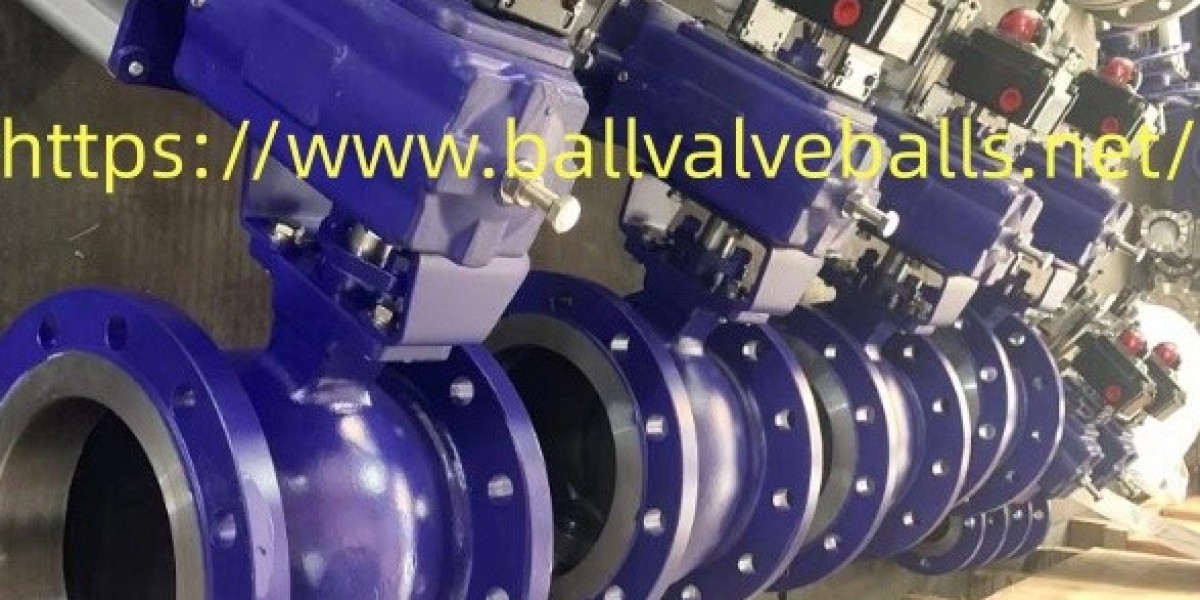
Hard Seal Ball is a spherical closure component used in industrial valve assemblies where controlled contact between the ball and seat is required to stop or permit fluid movement. Unlike designs that depend mainly on soft polymer contact surfaces, a hard sealing arrangement uses metallic or specially treated surfaces. The working principle is straightforward, but the manufacturing details behind it involve careful attention to geometry, surface condition, material selection, and contact between mating components.
Understanding The Basic Structure
A typical industrial ball valve contains a spherical closure element with a passage through its center. The element is positioned inside the valve body and connected to a stem or operating mechanism.
When the passage is aligned with the pipeline, fluid can move through the internal channel. When the spherical element rotates approximately one quarter turn, the passage moves away from the flow path and the solid outer surface moves toward the seating areas.
This simple rotational movement allows rapid opening and closing while keeping the operating mechanism relatively compact. The actual sealing result depends heavily on the relationship between the spherical surface and the surrounding seat.
How The Sealing Process Works
During closure, the spherical surface comes into controlled contact with the seat. The contact area needs to maintain suitable pressure across the mating surfaces so that the flow path is blocked.
In a hard sealing arrangement, both contact areas are designed to withstand mechanical interaction. Surface treatment may be applied to improve resistance to wear, erosion, or other operating conditions.
The geometry of the two surfaces is particularly important. Even a small dimensional difference can affect contact distribution, operating torque, and sealing behavior. This is why precision machining and finishing are important parts of component production.
Why Surface Treatment Matters
Industrial media can contain particles that gradually affect contacting surfaces. High temperature can also change dimensions through thermal expansion. These conditions make surface engineering an important consideration.
Depending on the intended application, manufacturers may use treatments involving tungsten carbide, chromium carbide, Stellite, or other engineered surface materials. The selected treatment should correspond with the operating environment rather than being treated as a universal solution.
After treatment, the contacting areas may require grinding or lapping. These processes help create the surface condition needed for controlled interaction between the mating components.
Applications In Industrial Systems
Hard sealing arrangements are commonly considered for services involving elevated temperatures, abrasive particles, pressure variations, or demanding process conditions. Applications can include petroleum processing, chemical production, power generation, mining, metallurgy, and other industrial operations.
For example, a process line carrying material with solid particles may create more mechanical wear than a clean fluid service. Similarly, high temperature can affect polymer based seating materials, making metallic contact surfaces a consideration for particular applications.
The suitability of a component still depends on the complete valve design and operating conditions. Buyers should therefore evaluate the entire assembly rather than selecting a component based on one characteristic.
Material Selection Requires Care
Material selection involves more than choosing a hard metal. The base material, surface treatment, process medium, temperature, pressure, corrosion conditions, and expected operating cycles all need to be considered together.
Stainless steel and alloy materials can be used in different applications, while specialized surface treatments can provide additional protection at the contact area. The appropriate combination depends on engineering requirements.
Ballvalveballs focuses on spherical valve components for industrial applications, giving valve manufacturers and purchasing teams options to consider according to their own assembly requirements.
Precision Influences Assembly
A spherical component needs to match its corresponding seat accurately. Diameter, roundness, surface roughness, bore position, and other dimensional characteristics can influence assembly and operating behavior.
Precision also matters during repeated opening and closing. If contact is uneven, certain areas may experience greater mechanical stress or wear.
For this reason, quality inspection should cover more than visual appearance. Dimensional verification and surface inspection can provide useful information before components are incorporated into a complete valve.
Selecting Components According To Service Conditions
A component intended for clean water service may have different requirements from one intended for abrasive slurry or high temperature process media. Buyers should provide suppliers with relevant operating information before making a selection.
Important considerations can include the type of medium, temperature range, pressure conditions, particle content, corrosion exposure, operating frequency, and required connection arrangement.
This information gives manufacturers a clearer basis for discussing materials and surface treatments. It also reduces the risk of selecting a component without considering the conditions it will encounter during actual operation.
Why Component Quality Matters
A valve assembly depends on the interaction between multiple parts. The spherical closure element, seat, stem, body, seals, and operating mechanism all need to work together.
A carefully manufactured component can contribute to predictable assembly and operation, but its performance should always be considered within the specifications of the complete valve.
Ballvalveballs offers component solutions for buyers who need to evaluate material choices, surface treatments, dimensional requirements, and application conditions as part of their industrial valve projects.
For manufacturers and purchasing teams reviewing suitable spherical components for upcoming valve projects, the available product information at https://www.ballvalveballs.net/ can be considered alongside the required application conditions and assembly requirements.