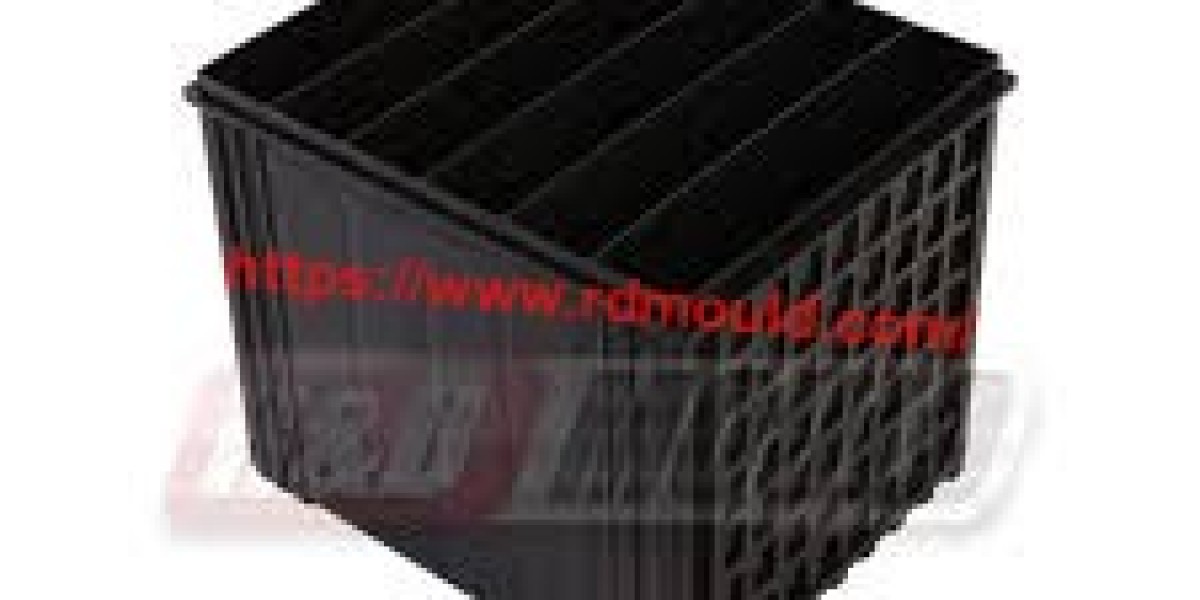
A large storage container comes out of the mould. The side walls bow inward. The base does not sit flat. A Plastic Box Mould from Rdmould, produced by R & D Mould Co., Ltd., prevents this through uniform wall thickness design. Yet many moulds produce containers that warp. This situation raises a direct question for any packaging manufacturer: how does a plastic box mould achieve uniform wall thickness to minimize shrinkage deformation in large storage containers?
The mould designer starts with runner balancing. A hot runner system with multiple gates feeds the cavity. Rdmould's engineering team uses Moldflow software to simulate filling. The simulation shows how the melt front moves across the part. An unbalanced runner fills one side of the box faster. The faster side starts cooling earlier. The slower side remains hot longer. The difference in cooling rates creates uneven shrinkage. A balanced runner delivers the melt to all gates at the same time. The entire cavity fills uniformly. The wall thickness stays consistent.
Core and cavity alignment prevents thickness variation. The moving plate holds the core. The stationary plate holds the cavity. Rdmould's moulds use tapered locking rings. The rings center the core inside the cavity. A misaligned core shifts to one side. The gap between core and cavity becomes narrower on one side of the box. The opposite side gap becomes wider. The narrow side produces thin walls. The wide side produces thick walls. A locking ring with an angle keeps the core centered under injection pressure.
Gate location determines the melt flow path. A gate at the center of a large box base sends melt outward in a radial pattern. Rdmould's central gate design works for square containers. The melt reaches each corner at the same time. A gate near one edge of the base causes the melt to wrap around the far side. The flow front splits and rejoins. The rejoined front creates a weld line with different orientation. The wall thickness at the weld line may differ from the surrounding area. A well placed gate eliminates these variations.
Conformal cooling channels follow the part contour. Drilled straight channels leave hot spots. Rdmould uses 3D printed or cast conformal channels. The channels run parallel to the box wall surfaces. The cooling water removes heat evenly from all areas. A straight channel drilled at an angle may come closer to the cavity in some spots. The closer channel cools that spot faster. The box wall becomes thinner there because the material shrinks more. A conformal channel maintains a constant distance from the cavity surface. The cooling rate stays uniform across the part.
Melt temperature control affects viscosity. A temperature drop in the runner causes the melt to thicken. Rdmould's hot runner system keeps the material at a consistent temperature. The thick melt flows slower into one area of the cavity. The slower flow fills that area later. The late filling area cools under less packing pressure. The resulting wall thickness drops. An insulated runner system with individual temperature zones prevents this problem. Each gate receives melt at the same temperature and viscosity.
Injection speed profiling compensates for geometry changes. A large box has thin ribs and thick corners. Rdmould's injection molding machine uses a multi stage injection profile. The first stage fills the thick base quickly. The second stage slows down for the vertical walls. The third stage packs out the corners. A constant speed cannot fill both thick and thin sections uniformly. The melt freezes in thin sections before the thick sections fill. The frozen section creates a short shot or a thin wall. The profiled speed matches the filling rate to the section thickness.
Ejector pin placement influences post mold warpage. The box shrinks onto the core as it cools. Rdmould's ejector pins push the box off the core. A pin that contacts the box too early causes distortion. The pin pushes the still soft plastic. The box wall bends at the contact point. The bent area has a different thickness after cooling. Retracted ejector pins release the box only after the box has solidified. The box maintains the wall thickness that the cavity created. The pins then push from multiple points to avoid bending.
Mould steel selection changes heat transfer rate. Steel with high thermal conductivity removes heat quickly. Rdmould's steel choice matches the plastic type. A fast cooling material like polypropylene works with standard steel. A slow cooling material like polycarbonate needs high conductivity steel. The correct steel grade pulls heat from the plastic at the right rate. The wall thickness remains uniform because the cooling happens evenly. The wrong steel grade creates hot and cold zones. The hot zones produce thicker walls where the plastic stayed molten longer.
For any manufacturer producing large storage containers, https://www.rdmould.com/news/industry-news/the-benefits-of-a-plastic-box-mould.html shows Rdmould's Plastic Box Mould design guide, where RuiDing engineers list runner balancing rules, conformal cooling channel layouts, and gate placement strategies for uniform wall thickness. A container with even walls stacks without wobbling. A container with uneven walls rocks on flat surfaces. Does your box sit straight on a pallet or lean toward the lighter side?