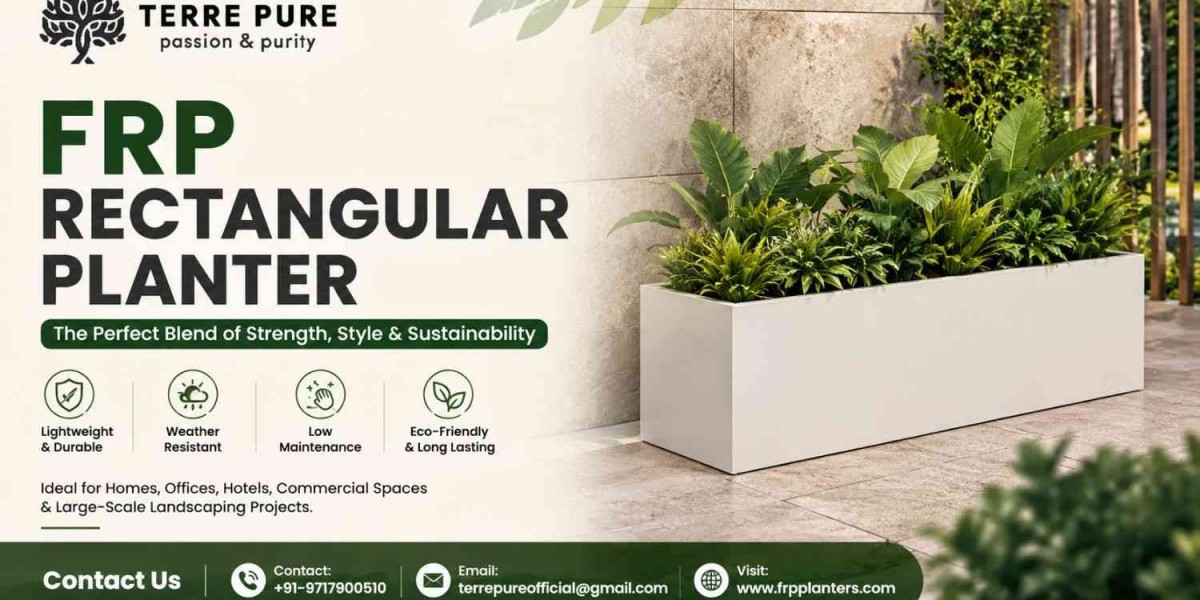
A nursery owner outside Chandigarh stocks three planter materials for three different customer requests — terracotta for buyers who want a traditional look, concrete for anyone building a permanent boundary wall garden, and FRP Rectangular Planter units for everyone in between who wants something that moves easily, survives outdoors, and doesn't need repainting every season. That middle category has grown faster than the other two combined over the past few years, and it's not hard to see why. Homeowners want something that looks premium without demanding upkeep. Designers want a material that holds a finish across a project's lifespan. Nobody wants to explain to a client why last year's planter is already fading.
Here's where FRP actually earns that versatility claim — and where it doesn't.
One Material, Several Applications — the Specs Behind It
Versatility only works if the underlying build genuinely supports different use cases. That comes down to layup choices most buyers never see.
Core Construction
An FRP Rectangular Planter is built from fiberglass matting bonded with polyester or vinyl ester resin, cured, and sealed with a gel coat rated for UV exposure. Indoor-use units can run a lighter 3mm wall thickness since they're not facing weather stress, while outdoor and commercial units need 4–6mm to handle sustained soil load and impact. Buyers who order the same spec for both settings are usually either overpaying indoors or underbuilding outdoors.
Format Range
Sizes range from compact 18-inch and smaller units for nurseries and patio gardens, to 60-inch-and-up modular for lobby and courtyard applications, with custom fabrication and detail for landscape applications. The various finish options matte, gloss, stone-texture each behave differently depending on the exposure to sunlight, and a sample finish can look vastly different under broad daylight once it is installed.
What Buyers Miss When Comparing Options
Moveability as opposed to fixed location. The lightness of FRP is undeniably a benefit at plant nurseries and for homeowners seeking flexible season-to-season repositioning of planters, but the project also posed a problem of course for large fully loaded units, which require a solid, even foundation in order to be stable.
Five Questions to Ask Regardless of Which Setting You're Buying For
Whether you're a nursery stocking retail units or a designer specifying a lobby installation, these five questions separate a real supplier from a risky one.
- What wall thickness applies to my specific use case? A bad answer is a single generic number for every order. Indoor, outdoor, and commercial applications genuinely need different specs — a supplier who doesn't ask which one you need isn't paying attention.
- What's the expected color lifespan under direct sun? A bad answer is "our finish doesn't fade." Every gel coat degrades eventually — a real supplier states a realistic timeline and the stabilizer used to extend it.
- What happens if a retail-stocked unit is damaged before sale? A bad answer is silence, or "that's the retailer's problem." Nurseries need a clear return or exchange policy stated upfront, not discovered after a damaged batch arrives.
- Can you provide a sample before a bulk order? A bad answer is "samples aren't available below a certain quantity" with no further explanation. Ask for the real threshold — it's rarely what's advertised.
- What's your current lead time for a mixed-size order? A bad answer treats a 40-unit mixed order the same as a 40-unit single-size order. Mixed orders take longer to produce — a supplier should say so plainly.
Why Versatility Actually Reduces Risk, Not Just Choice
The word “versatile” sounds quite marketing related. This is what it is protecting for the buyer side.
Having a steel-reinforced FRP planter that is about 60% lighter than the corresponding concrete variants reduces the burden on the nursery to have a wide selection of items on display and available for immediate purchase without risking the floor, and on the customer to achieve variety in a balcony or terrace layout without additional assistance and costs. Freedom from the effects of UV stabilizes the gel coat surface and enables equal indoor or outdoor deployment, such that only one product needs to be designed and manufactured to meet the general needs of two very different classes of user a designer's ease and the end user's bottom line. The molded integrity afforded the nursery seems trivial but is in fact enabling, as for material that is batch-variable to be able to display a product sample and knowing that the next unit coming off the line is identical is a real advantage over hand-finished stone that can't. Cost-effective low maintenance is also essential in protecting margin for garden center: not having to repaint or reseal the product again before reselling demands fewer resources of truck, labor and shelve space.
Where the limits of versatility are reached: commercial areas where the commercial units are 'indefatigably hammered by a butch traffic overnight, are still better served by thicker-gauge, purpose-built commercial units than by an all-round indoor/outdoor spec. One size really doesn't fit all, regardless of a supplier who says so.
Where to Source FRP Rectangular Planters Across India
More than catalog price go on any market in the world. But to lead to a once in a lifetime business opportunity. Overview, no matter if you working as a Mumbai interior designer, a market in Punjab, door to door, making decisions about shopping etc.
Most of the buying population south and west of Delhi NCR end up within a two to four day freight radius of production, as this is significant to a nursery of seasonal restocking, as well as a fixed deadline for a project. Designers and C&PD teams working with FRP Rectangular Planter suppliers in India on relatively small and repeat orders prefer suppliers who specialize in selling partial truck loads (not every FRP Rectangular Planter manufacturer is set up to efficiently deliver many small batches in the same way the 3000 unit one-off large commercial project delivery).
One more thing to watch for, a size more discrete than stated months in advance for special orders. For example, some manufacturers have minimum time constraints on special/niche colors or sizes based on cumulative order value that can make regular nursery orders unfeasibly small in the long run. If possible check to see if standard catalog 100s are available before considering order as custom in both dimensions.
About Us
We began manufacturing FRP planters in 2013 and have grown to 3 production facilities exporting to 31 countries, but the range of buyers we work with is what actually shaped our catalogue. Nurseries taught us that stock consistency matters as much as design — one Ludhiana garden center pulled an order in 2020 after finding a visible shade variance across a 30-unit batch, and that pushed us to tighten our gel coat color-matching process across every production run since. We still run manual color checks against a reference swatch for every batch, which slows output slightly but has cut shade-variance complaints close to zero. It's a small process most buyers never see, and it's exactly why a nursery can order from us twice and get a matching product both times.
Get a Quote — Tell Us Your Use Case
Send us your required dimensions, quantity, finish preference, and whether the units are for indoor, outdoor, or commercial use, to Standard catalog sizes ship with no minimum order; custom sizes carry a 20-unit MOQ. We respond with a formal quote and lead-time estimate within 24 business hours, and we can send a physical sample ahead of a full order. That's how FRP Planters works with everyone from single-store nurses to full-scale landscape architecture firms.
Conclusion
The real test of an FRP Rectangular Planter isn't how it looks in one setting — it's whether the same build genuinely performs indoors, outdoors, and in between without compromise. Get the wall thickness and finish matched to the actual use case, and that versatility claim holds up in practice, not just in a catalog description. The buyers specifying that distinction now are the ones who won't be sourcing three different materials for three different rooms next year.
FAQs
Can the same FRP Rectangular Planter be used both indoors and outdoors?
Generally yes if it's built to outdoor spec, although a lighter indoor-only unit won't hold up outside — always confirm which spec you're ordering before assuming it covers both.
Do FRP Rectangular Planter manufacturers in India support small recurring orders for nurseries?
Some do more readily than others — larger manufacturers focused on commercial bulk orders sometimes deprioritize small repeat orders, so it's worth confirming that upfront rather than assuming.
How does an FRP Rectangular Planter compare to terracotta for a home garden?
FRP costs more initially but doesn't crack in freeze-thaw cycles or absorb water the way terracotta does — a genuine trade-off between upfront cost and long-term durability worth weighing against your climate.
Can FRP Rectangular Planter suppliers in India match a custom color across multiple orders?
Reputable suppliers maintain color reference swatches specifically to ensure this, but it's a fair question to ask directly — not every manufacturer has that process in place.
Is an FRP Rectangular Planter heavy enough to stay stable outdoors?
Once filled with soil, yes for most standard placements, although very large units on uneven or loose ground carry a real tipping risk that a heavier concrete planter wouldn't. Check the base footprint against your surface.