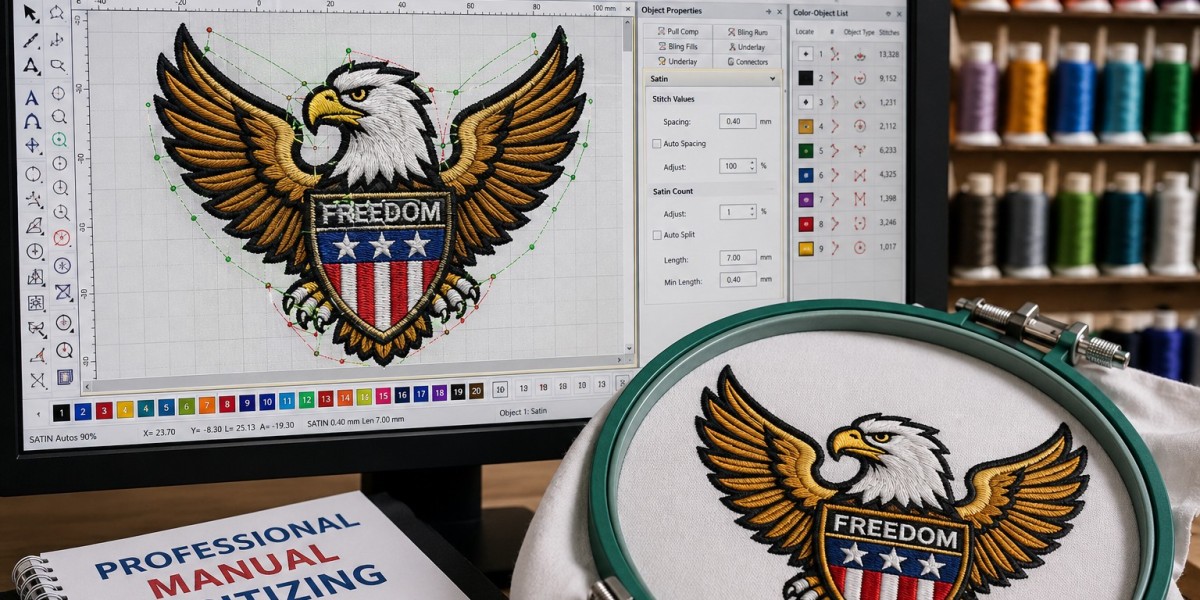
Understanding the Value of Manual Digitizing in Modern Embroidery Workflows
In the embroidery industry, precision is everything. Every stitch, density adjustment, and pathing decision impacts the final outcome of a design. Many production errors, thread breaks, and distorted logos occur not because of machine limitations, but due to poorly planned digitizing methods. This is where structured manual techniques become essential for consistent, high-quality results.
One of the most reliable approaches used by experienced digitizers is professional manual digitizing , a method that gives full control over stitch types, directions, and sequencing. Unlike automated software-generated outputs, manual control allows fine-tuning for fabric behavior, stitch balance, and design complexity. This ensures embroidery looks clean, sharp, and durable across different materials.
Why Embroidery Problems Often Occur
Most embroidery issues are not random; they usually stem from improper digitizing decisions. Some of the most common problems include:
- Thread breaks during stitching
- Poor alignment on caps or curved surfaces
- Fabric puckering or stretching
- Inconsistent stitch density
- Loss of detail in small text or logos
These issues often happen when designs are converted without considering fabric type or stitch behavior. For example, a design optimized for cotton may fail on polyester or caps due to differences in tension and stability.
How Manual Control Improves Quality
A key advantage of manual digitizing is the ability to control every element of stitch formation. Instead of relying on automatic fill patterns, a digitizer can:
- Adjust stitch angles for better texture
- Reduce density in sensitive fabric areas
- Add underlay for stability
- Optimize stitch paths to reduce thread breaks
- Improve edge sharpness in small details
This level of control directly impacts embroidery durability and appearance. For instance, adjusting underlay stitches can prevent fabric shifting during production, which is a common cause of misalignment in large orders.
Solving Production Inefficiencies
Production speed is often affected by repeated machine stops, thread trimming, and rework caused by poor digitizing. A refined manual approach reduces these inefficiencies by planning stitch flow in advance.
Key improvements include:
- Fewer machine stoppages due to optimized stitch sequencing
- Reduced thread consumption through controlled density
- Faster production cycles with cleaner machine runs
- Lower rejection rates in bulk orders
When designs are properly structured from the beginning, machines operate smoothly, resulting in higher output and less waste.
Handling Complex Designs
Complex logos, gradients, and small text require careful planning. Automated tools often struggle with fine detail conversion, especially when scaling is involved. Manual methods allow digitizers to interpret design intent rather than simply converting pixels into points.
For example:
- Small lettering requires adjusted pull compensation
- Gradient fills need controlled stitch layering
- Thin lines must be reinforced without over-density
This ensures that even highly detailed artwork remains readable and visually consistent after embroidery.
Fabric Considerations and Stitch Adaptation
Different fabrics behave differently under embroidery pressure. A structured approach helps adjust stitch settings based on material type:
- Cotton: absorbs stitches well but may shrink slightly
- Polyester: stable but prone to thread visibility issues
- Caps: curved surface requires special pathing
- Knits: flexible but sensitive to high density
Understanding fabric behavior is essential to avoid distortion. Proper planning ensures the design remains stable regardless of garment type.
Reducing Rework and Improving Consistency
One major challenge in embroidery production is rework caused by inconsistent digitizing quality. When designs are not standardized, each order may behave differently during stitching.
A controlled manual approach ensures:
- Uniform stitch quality across batches
- Repeatable results for recurring orders
- Easier scaling for large production runs
- Reduced dependency on machine adjustments
Consistency is especially important for branding, where logos must remain identical across thousands of garments.
Workflow Optimization in Digitizing
Efficient digitizing is not just about drawing stitches—it is about planning workflow. A structured process includes:
- Analyzing artwork and identifying stitch types
- Selecting appropriate underlay techniques
- Defining stitch direction for smooth texture
- Testing density balance for fabric type
- Finalizing file for machine compatibility
This step-by-step approach reduces guesswork and improves production reliability.
Business Impact of High-Quality Digitization
Better digitizing directly improves business performance. Reduced errors mean faster delivery times, higher customer satisfaction, and fewer returns. It also increases machine uptime, which translates to better profitability per order.
Companies that invest in skilled manual digitizing typically experience:
- Stronger client retention
- Higher repeat order rates
- Improved brand reputation
- Lower production waste
These benefits make digitizing quality a core competitive factor in the embroidery industry.
Final Insight
The success of embroidery production depends heavily on how well a design is prepared before it reaches the machine. While automation tools can assist in basic conversions, precision work still requires human expertise and judgment. Skilled digitizers bring control, adaptability, and problem-solving ability that software alone cannot replicate.
When applied correctly, professional manual digitizing becomes the foundation of consistent embroidery quality, reducing errors and ensuring every design meets production standards without compromise.